Do
Let the plan dominate. Attach concise information to a clear location.

Green Finger Paint design language
Turn a garden plan into a living guide to what is growing where, what needs attention, and what to do next.
The garden is the hero. The interface is an annotation layer.
01
Core principle
Source plans retain their contrast and authority. Green Finger Paint adds only the information needed to understand, review, or care for the garden.
Let the plan dominate. Attach concise information to a clear location.
Cover the garden with generic cards or turn the plan into decoration.
02
Living Plan mark
The original mark remains canonical. Its full upper-right leaf balances the open plan contour and stays recognizable at the smallest product sizes.






Six localized lockups share the same mark, spacing, and hierarchy.
03
Annotation grammar
Every state combines color with a symbol. Confidence never becomes confirmation; confirmation requires an explicit trusted action or source.
Found by the system and still presented as a detection.
Unresolved or explicitly asking for human attention.
Verified by a trusted source or explicit user action.
Human-authored placement or correction with provenance retained.
A maintenance action attached to a garden object.
Evidence in the uploaded drawing. Never restyled as product UI.
A dashed interface callout joining our marker to our information.
04
Color architecture
Foundation colors describe the world; semantic tokens describe their job.
#1C1A14#2D4A2A#4A7C45#8BAF7C#D4E6C8#F5F0E8#FAF7F2#C4855A#6B9EAFmoss + chalkmuted-inkclay + soilYour garden tells a living story.
Review the plants in North border
Geranium macrorrhizum
BED 02 18.4 M² 12 PLANTS
05
Shape language
Interface structure stays precise. Garden-derived content earns the organic curves.
Structural UI
6–12px radii, clear alignment, restrained hierarchy.
Organic garden geometry
Bed contours, planting canopies, plan crops, and botanical illustration.
06
Imagery
Three image modes create one recurring explanatory sequence.
Top-down and spatial. The source drawing stays readable.
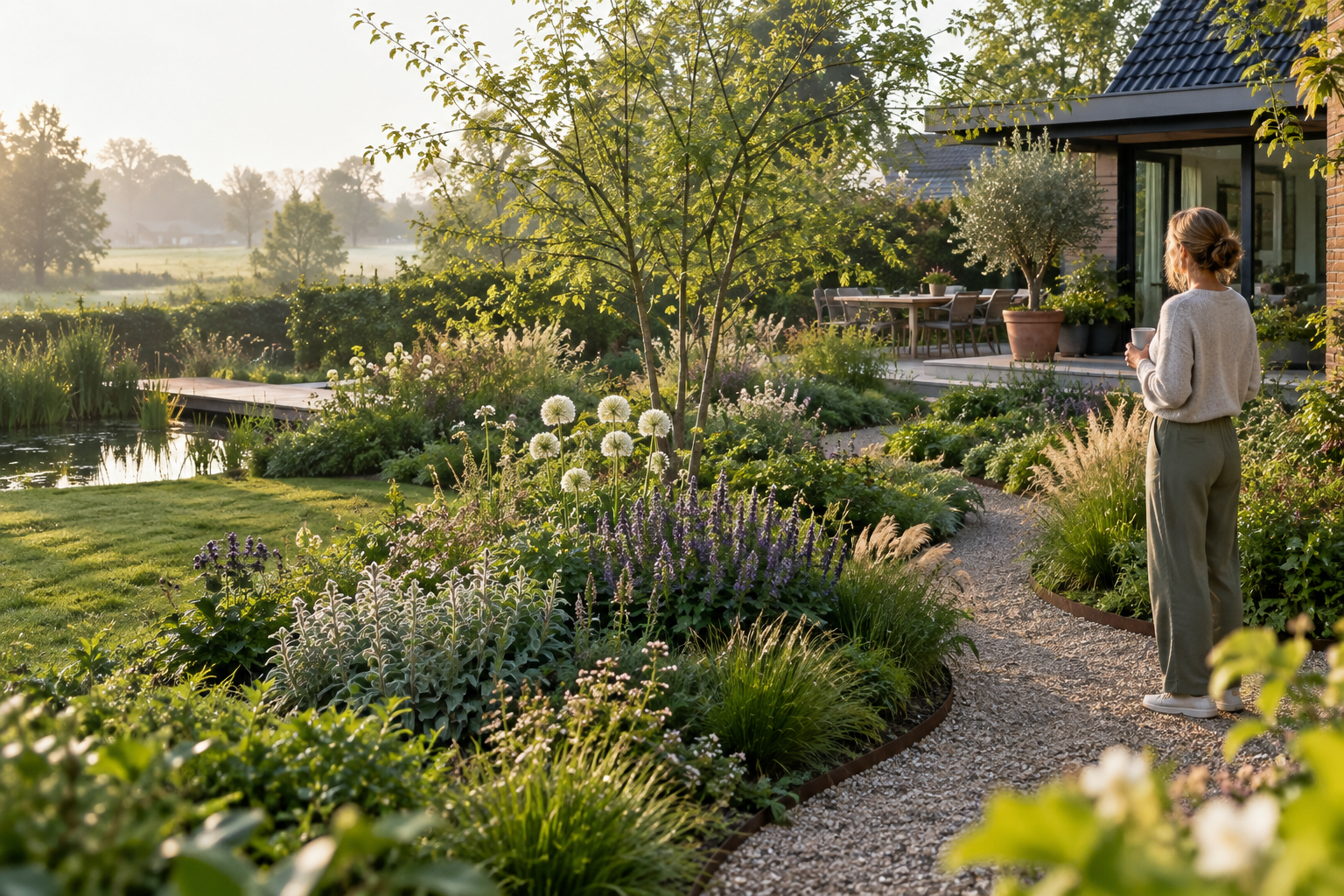
Believable residential scale, never generic aspiration.
Foliage, flowers, pruning points, growth, and damage.
The visual story ends in useful garden care.
07
Motion
Motion explains attachment, tracing, and state change. Reduced-motion users receive the final state immediately.
08
Implementation
Production assets and machine-readable tokens remain the source for implementation.
• ? ✓ + !.ADR-072 · Material
The garden plan continues beneath floating tools. Warm cream by day, deep bark by night. Photography and annotations keep their full contrast.
Warm parchment · 24px blur
Lavandula angustifolia
Deep bark · 24px blur
Lavandula angustifolia
20px toolbar corners; 24px inspectors. Opaque fallback for reduced transparency and unsupported browsers. Species names are upright; amber with a question mark remains reserved for plants needing a check.
